The Boss Key They Cut
Microsoft's own intern built Solitaire a button to hide it from your boss. They made him take it out before release — then spent the next decade proving they'd needed it.
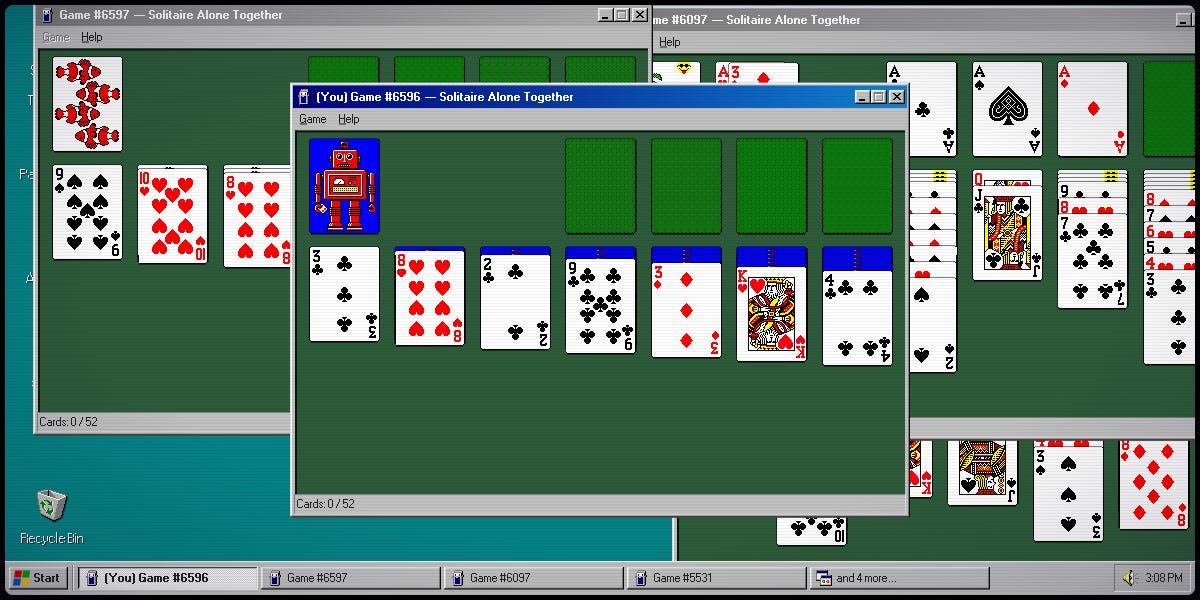
This week, in a gallery in Chelsea, an internet artist took the loneliest program ever bundled with an operating system and made it crowded. Solitaire Alone Together, by Nolen Royalty, looks exactly like Windows 98's built-in game — green felt, blue titlebar, that little robot card back — except every window open on the screen belongs to a stranger, playing somewhere else on the internet right now, dragging cards you can watch and never touch. “It's more social than solitaire was 30 years ago,” Royalty wrote about it, “but it's also a little lonely.” It's one of twenty pieces in Websites Websites Websites, marking 30 years of Rhizome, the net-art nonprofit — up through Sunday.
Rewind to 1988. Wes Cherry was a summer intern at Microsoft, and he wrote the game on his own time, copying the rules from a solitaire program he liked on the Mac. When it shipped with Windows 3.0 in May 1990, Microsoft's reason for including it wasn't fun. Office workers coming off DOS had never had to hold a mouse and drag something with it — the one motion the entire graphical interface depended on — and the company needed a way to teach that motion without anyone noticing they were being trained.
Cherry built one more thing into his version: a boss key. Hit it, and the game vanished behind a fake spreadsheet full of meaningless numbers, built to survive a glance over a cubicle wall. Microsoft made him cut it before release. They wanted Windows to look professional.
Cutting it changed nothing. By 1994 Sears was stripping the built-in games off every computer in the company, telling the Wall Street Journal it was clogging the internal network. In 1995 Virginia's governor ordered games deleted from all 103,000 state computers. A Gartner study that same year put the national cost at 26 million lost work-hours a year, something like $750 million in wages — spent on a card game that had been installed, specifically, to teach people how to work the machine.
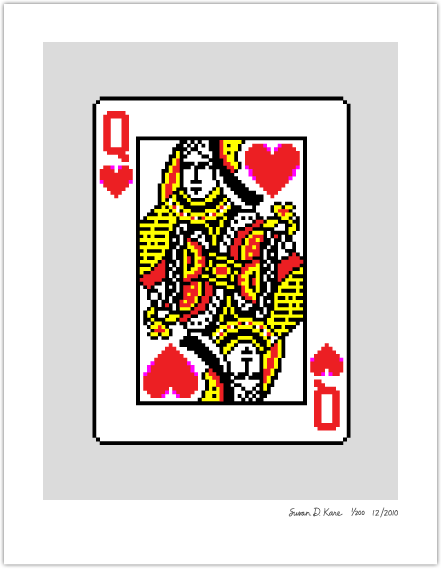
Susan Kare drew the cards, the same year she was still finishing the rest of the Mac's visual language. In 2015, for Solitaire's 25th anniversary, Areaware turned her pixel deck into a real box of playing cards and asked her for two jokers — the on-screen game never needed any, a real deck does. That run's long gone. What's still there is her own shop, where the Queen of Hearts is a hand-signed, numbered archival print, $259, printed to order.
Nobody's found the boss key file in thirty-six years of Windows source leaks. As far as anyone knows, Cherry's version never left Microsoft's building.