One of Our Best Sellers
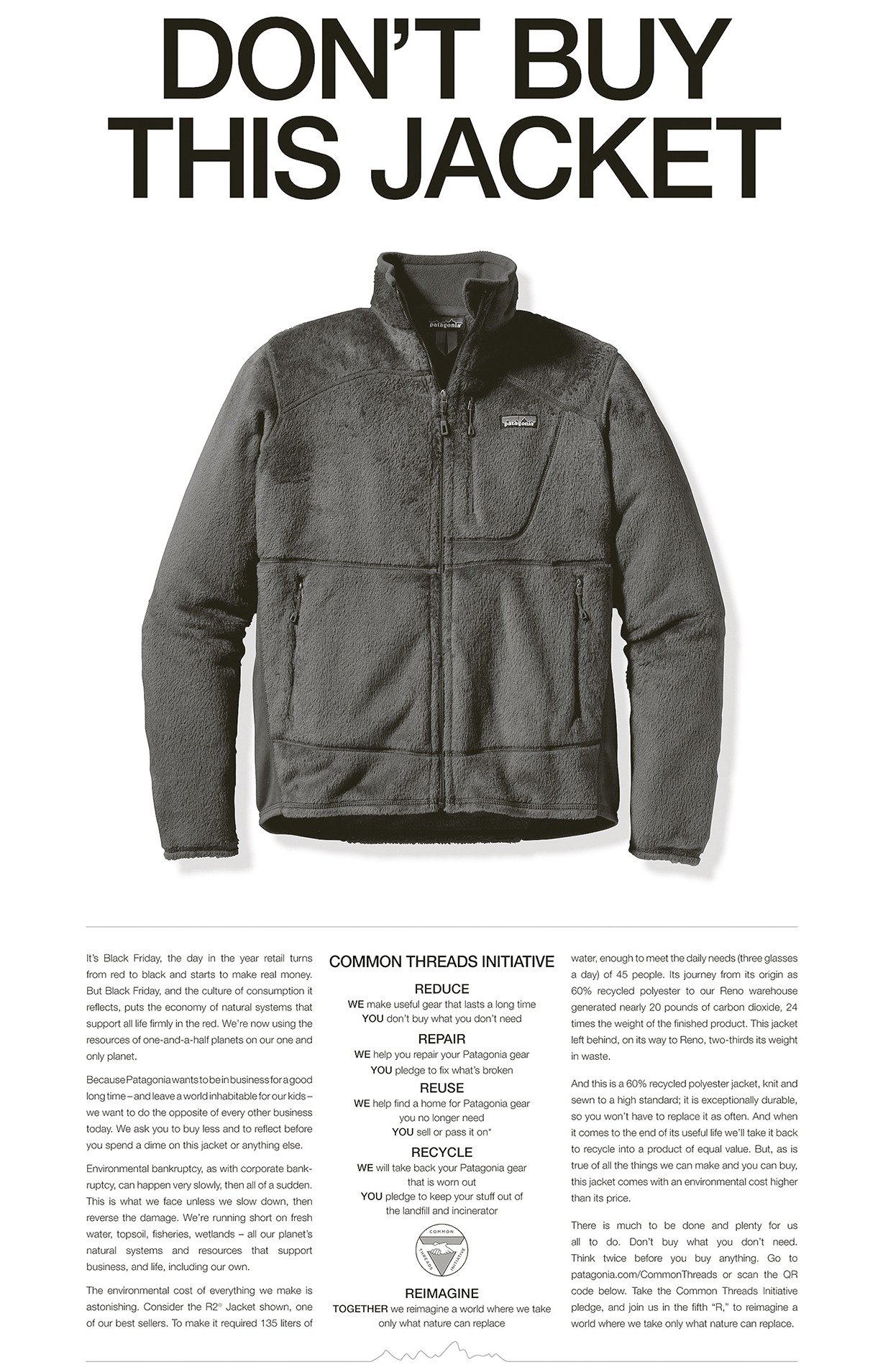
Fifteen years ago this Black Friday, Patagonia bought a full page in The New York Times to tell readers not to buy its jacket. The ad itself called the jacket one of its best sellers.
On Friday, November 25, 2011, readers of The New York Times turned to a full-page ad with three words across the top in huge black capitals: DON'T BUY THIS JACKET. Under them was a gray zip-up fleece, Patagonia's R2. The copy started with the date: "It's Black Friday, the day in the year retail turns from red to black and starts to make real money." Then it asked readers "to buy less and to reflect before you spend a dime on this jacket or anything else."
The small print did the math on one jacket. "Consider the R2® Jacket shown, one of our best sellers," it said. Making it took 135 liters of water, "enough to meet the daily needs (three glasses a day) of 45 people." Getting it from raw material to Patagonia's Reno warehouse generated nearly 20 pounds of carbon dioxide, 24 times the weight of the jacket, and left behind two-thirds of its weight in waste. "Don't buy what you don't need," the ad finished. "Think twice before you buy anything."
David Gelles tells how it got made in Dirtbag Billionaire, his 2025 book about Yvon Chouinard, and posted the excerpt last Black Friday. The idea came from Rick Ridgeway, a Patagonia executive and mountaineer. His first pitch was to close every Patagonia store on Black Friday and wrap them in crime-scene tape. "That didn't fly." The board's skeptic was Kris McDivitt Tompkins, Patagonia's former CEO, who worried about "inauthentic marketing gimmickry." (She went on to donate the land for Argentina's Iberá National Park, in Corrientes, which Congress approved in 2018.) Ridgeway reworked it around Common Threads, Patagonia's reduce-repair-reuse-recycle pledge, and it ran.

The trade press called it a "brilliantly subversive bit of marketing." Business schools wrote it up as a case study. You'll often read that it lifted sales 30%, a number we couldn't trace to Patagonia. The number Gelles did get came from Casey Sheahan, Patagonia's CEO at the time: "For that $57,000 ad in The New York Times, we got $40 million to $50 million of free publicity."
In the months and years that followed, Gelles writes, the company's sales hit new heights.